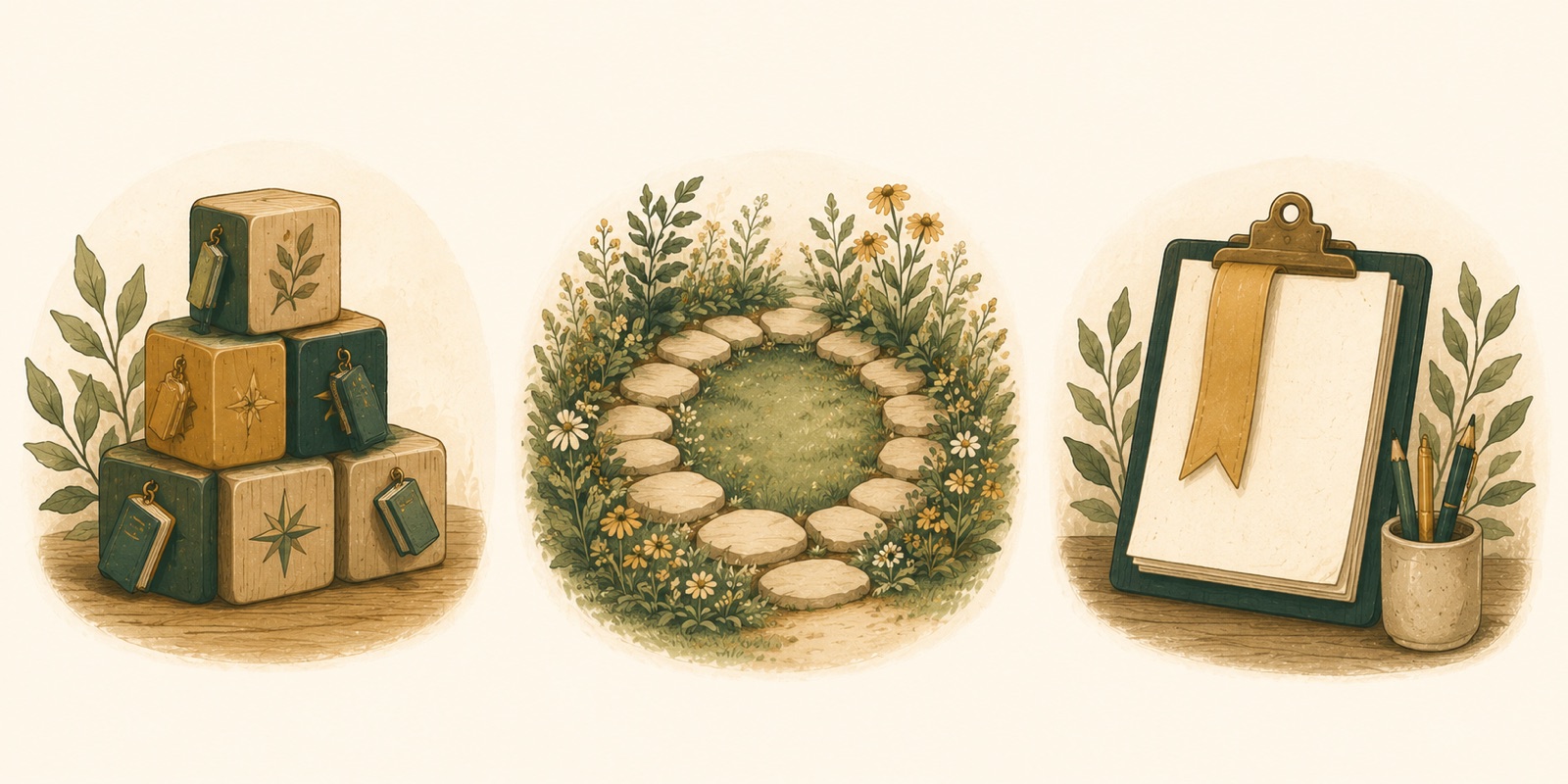
The curriculum is chosen, the books are on the shelf — and now comes the question that shapes your actual days more than any curriculum ever will: what does a school day look like at your house? Nearly all homeschool schedule types boil down to three families — the block schedule, the loop schedule, and the checklist schedule — and most scheduling misery comes from running one that fights your temperament instead of fitting it. Here's how each works, where each one cracks, and how to pick before you build a whole year around the wrong one.
The block schedule: homeschool by the clock
A block schedule is the one everybody pictures first, because it looks like school: the day is divided into fixed time blocks with a subject assigned to each. Math from 9:00 to 9:45, read-aloud from 9:45 to 10:15, break, then writing. Every subject has a home on the clock, and the clock decides when you move on.
Who thrives on it: families who genuinely love structure. Kids who relax when they know exactly what's coming next. Parents juggling multiple students, where "I work with the seven-year-old while the ten-year-old does independent math" only functions if both of those things happen at the same time every day. If your child asks "what are we doing next?" forty times a morning, a block schedule answers it once, permanently.
Where it cracks: the clock doesn't care that the math lesson needed fifteen more minutes, or that the toddler flooded the bathroom at 9:20. Miss a block and it's simply gone — and a block schedule quietly teaches you to feel behind the moment real life brushes against it. Time-sensitive temperaments can spend more energy defending the schedule than teaching from it.
Loop scheduling: do the next thing
Loop scheduling drops the clock entirely. You put subjects in a repeating list — say: nature study, art, composer study, geography, poetry — and whenever you have a slot for "loop time," you simply do the next subject in the loop. When you reach the bottom, you start over at the top.
The magic is what the loop makes impossible: falling behind. There is no "we were supposed to do art on Tuesday and didn't." There is only the next thing in the loop, done whenever loop time comes around. Sick day? The loop just waits. Co-op ran long? The loop just waits. Every subject still gets regular, roughly even attention over the weeks — it just isn't chained to a particular weekday.
Who thrives on it: families with unpredictable weeks, parents recovering from schedule guilt, and anyone whose "extras" — art, music, nature study — keep getting skipped because they were parked on the day that always blows up. Loops are famously good at rescuing exactly those subjects.
Where it cracks: loops are vague about volume. Because nothing is ever "missed," a slow drift is invisible — you can look up in November and realize the loop only turned over four times since September. Daily-progression subjects like math and phonics generally shouldn't live in a loop at all; they need to happen most days, in order.
The checklist schedule: a list, not a rigid schedule
A checklist schedule says: here is what needs to get done today — in any order, at any time. Each child gets a daily list (math lesson, copywork, twenty minutes of reading, science), and the school day is over when the list is done, whether that's 11:30 a.m. or after dinner.
Who thrives on it: independent workers, especially older students — a checklist is basically training wheels for how adults actually manage work. Kids who bristle at being told when often stop fighting entirely once they control the order. It also suits parents who'd rather inspect finished work than direct traffic all morning.
Where it cracks: a checklist assumes some self-direction, which young children don't have yet — a six-year-old with a list still needs you beside them for most of it. The hard items reliably migrate to the end of the day, when everyone is tired. And subjects that need you at a particular moment (a group read-aloud, a lesson taught to three kids at once) don't fit a purely order-free list.
The honest comparison
- Block: maximum predictability and the easiest way to coordinate multiple kids — but brittle, and the first to generate guilt when life interferes.
- Loop: immune to "behind," wonderful for the oft-skipped subjects — but fuzzy on pace, and wrong for skills that need daily, ordered progress.
- Checklist: builds independence and flexes around real life — but needs kids old enough to steer, and offers no help with when shared, parent-led work happens.
Notice that every one of these is a real tradeoff, not a flaw someone forgot to fix. There is no winner. There's only a fit.
Hybrids are normal (and probably where you'll land)
Talk to ten veteran homeschoolers and you'll find maybe one running a pure version of anything. The most common real-world pattern is a hybrid: block the mornings, loop the afternoons. The daily-progression subjects — math, phonics, writing — get a predictable morning block while everyone's fresh; the content-rich extras — history read-alouds, art, nature study, composer study — live in an afternoon loop that never falls behind. Older kids often get their independent work as a checklist inside that same structure. Mixing isn't a compromise or a failure of commitment; it's matching each subject to the structure it actually needs.
How to actually pick
Two rules make this decision much easier than it looks.
First, match your temperament, not your aspiration. The parent who buys the beautiful timed schedule is often the parent who most hates being ruled by a clock. Be honest: does a fixed structure calm you or cage you? Does open-endedness free you or dissolve you? Schedule for the person who shows up at 8 a.m. on a hard Tuesday, not the idealized planner of early August.
Second, design for your most chaotic weekday, not your ideal week. Any schedule survives a perfect Monday. Pick your messiest recurring day — co-op day, the day with therapy appointments, the day the baby skips a nap — and ask which structure survives that. A schedule that only works on ideal weeks isn't a schedule; it's a wish. This is the same principle behind planning the whole year around your real constraints first, which we walk through step by step in our guide to planning your whole homeschool year — skeleton first, sequences second, dates last.
Permission to switch mid-year
Finally, the part nobody says out loud: you're allowed to change your mind in November. Choosing a schedule type isn't a wedding vow — it's a working hypothesis, and the only way to test it is to live in it for six weeks. If the blocks are generating more guilt than order, loop the afternoons. If the loop is drifting, put math back on the clock. Kids grow into checklists that would have flopped a year earlier. The structure serves the family, never the other way around.
And this is one place a good tool genuinely helps: because Lumen Domus Schola plans your subjects as sequences rather than hard-coded dates, the same year's plan can be lived as blocks, loops, checklists, or any hybrid of the three — and switching structures in November means adjusting the rhythm, not erasing four months of planner pages.
Pick the one that fits the family you actually have this year. Then hold it loosely.
Plan your year with Lumen Domus Schola
Lumen Domus Schola is open now and runs right in your browser — the iPhone and Android apps come this fall. Try everything free for 5 days; cancel before the trial ends and you pay nothing.
Start your 5-day free trial