If you're teaching three children in three grades, the arithmetic is brutal: eight subjects apiece, taught separately, is twenty-four lessons a day and a mother with nothing left by noon. Combining subjects across grade levels is the single change that makes a multi-age homeschool sustainable — but it only works if you know which subjects can be combined and which absolutely cannot.
The dividing line: skill subjects and content subjects
Every subject in your house falls into one of two categories, and the category decides everything.
Skill subjects are cumulative and individual — math, phonics, reading, handwriting, formal writing. They build in a strict order, each step resting on the one before. Your child cannot do long division without multiplication facts, no matter who else is at the table. You have to teach these at each child's own level, period — combining them helps nobody and holds somebody back.
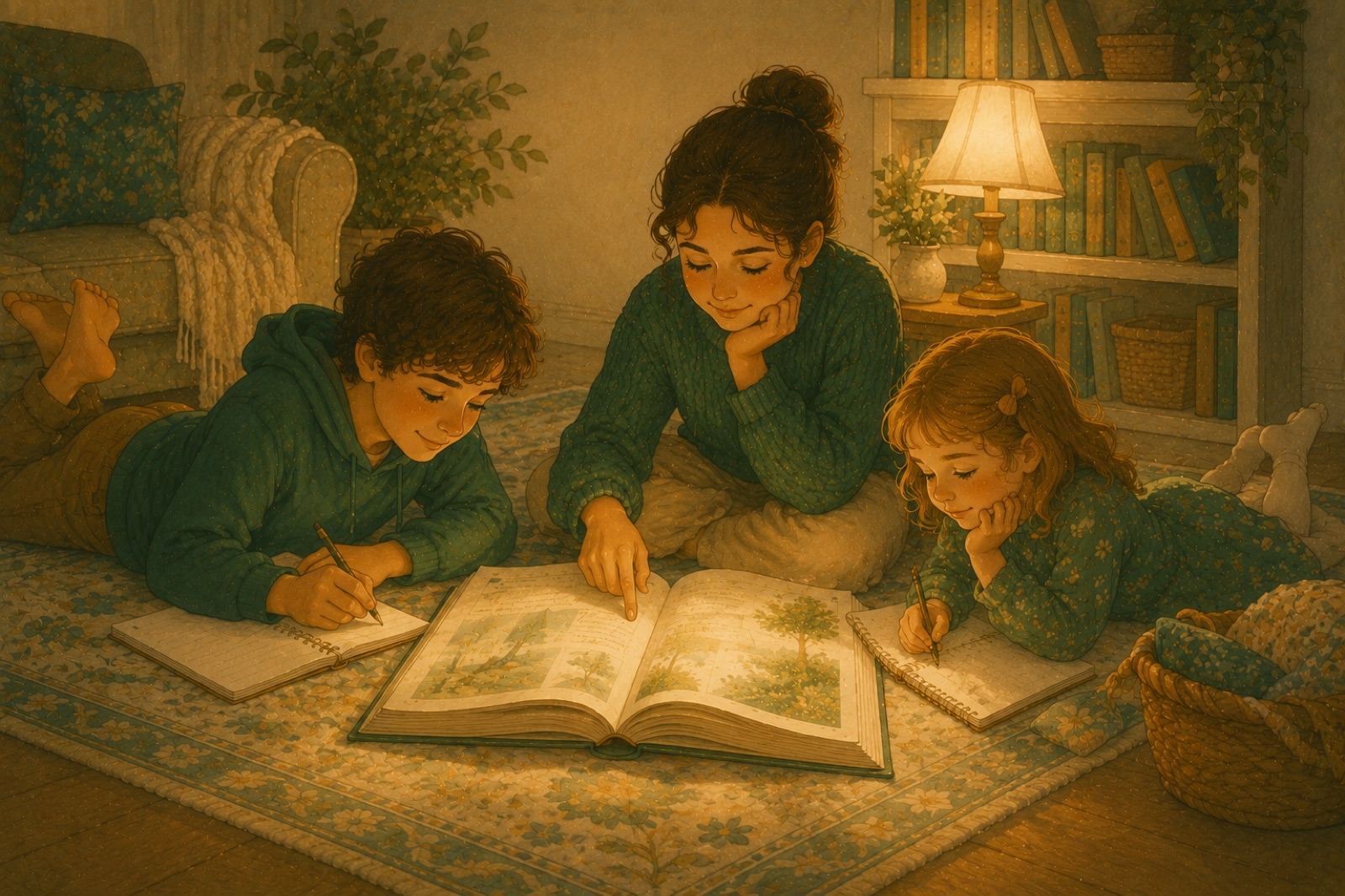
Content subjects are about knowing things rather than mastering a sequence — history, science, geography, art, music, nature study, literature, religious study. There's no reason your seven-year-old and your eleven-year-old can't learn about ancient Egypt in the same room, from the same book, on the same afternoon. They'll take different things from it, and that's fine, because knowing about Egypt has no prerequisites.
Teach skills individually. Teach content together. Nearly every multi-age scheduling problem is a violation of that one line.
What combining actually looks like
The practical version: your morning holds short, individual, one-on-one skill lessons — fifteen minutes of math with each child in turn while the others work independently — and your afternoon holds one combined content block that everybody attends.
That afternoon block is one lesson you prepare, one book you read aloud, one discussion you lead, one project on the table. Instead of teaching history three times, you teach it once — to three children. The time saved is not marginal. Families who make this switch routinely recover two hours a day.
It also transforms the feel of the day. Combined subjects are the ones your children will remember doing together — the map on the floor, the argument about whether the Romans were the villains, the volcano in the kitchen. Separate desks in separate rooms is not why most families chose home education.
Differentiate the output, not the input
Your obvious worry is that one book can't serve a seven-year-old and a twelve-year-old at once. It can — as long as everyone takes in the same material and each child produces something different from it.
- The youngest narrates or draws. "Tell me what happened" is a complete assignment for a six- or seven-year-old, and narration is genuinely rigorous — it requires holding and reorganizing the whole story.
- The middle child writes a few sentences. A short paragraph, a labeled map, a timeline entry. Enough to practice writing without the content becoming a writing lesson.
- The oldest writes properly or goes deeper. A page, an argument, an extra source, a project. This is where a twelve-year-old gets the rigor a shared read-aloud alone wouldn't give them.
- Everyone answers the same discussion question out loud. This is the part people skip, and it's the most valuable — hearing an older sibling reason through something is instructive in a way no worksheet is.
Same input, three outputs, one preparation. That's the whole method.
The read-aloud is the anchor
If you combine nothing else, combine the read-aloud. One book, everyone on the sofa, fifteen to thirty minutes a day. It carries history, literature, vocabulary, and comprehension all at once, it needs no preparation beyond opening the book, and it's the piece of your day your children will ask for by name.
Pitch it slightly above your middle child. Younger ones absorb far more than they can produce — your five-year-old listening to a book written for nine-year-olds is doing exactly what builds vocabulary — and your oldest will rarely object to a good story well told.
Where combining goes wrong
Three failure modes are worth naming, because each one is fixable.
Combining a skill subject anyway. Usually math, usually because the ages seem close enough. It produces a bored older child and a lost younger one within two weeks. If you've done this, uncombine it — fifteen minutes each is far cheaper than the damage.
Pitching to the youngest. Your combined lesson quietly becomes a lesson for the six-year-old that the eleven-year-old sits through. Aim at the middle and stretch the youngest — children rise to material above them far more readily than they engage with material beneath them.
Combining so much that nobody gets you alone. Every one of your children needs some minutes that are theirs. Your one-on-one skill lessons are usually where that happens — which is another reason not to collapse them.
Keeping one plan for several children
The scheduling wrinkle in all this is that your plan now has two shapes at once — individual sequences for the skill subjects and shared ones for the content. On paper that means either duplicating the shared subjects into every child's plan and updating them all whenever anything moves, or keeping them somewhere separate and hoping you remember.
This is exactly what Lumen Domus Schola is built to hold: each child carries their own math and reading sequences at their own pace, while a shared lesson shows up as a single item across everyone who's in it — check it off once and it's done for all of them. Your day view shows the real shape of the morning, three short individual lessons and one block you teach to the whole crew, without you maintaining that arrangement by hand. For the wider logistics of running several children from one calendar, see homeschooling multiple kids.
One family, learning together
Combining subjects is usually adopted as a survival tactic — and then quietly becomes the part of homeschooling families love most. Children who study the same period of history for years develop a shared vocabulary and a set of references that belong to your household. The eleven-year-old explains something to the seven-year-old and understands it better for having said it.
Teach the skills one at a time, because they have to be. Teach everything else with everyone in the room. It's less work and a better education, which is a combination you don't get offered often.
Plan your year with Lumen Domus Schola
Lumen Domus Schola is open now and runs right in your browser — the iPhone and Android apps come this fall. Try everything free for 5 days; cancel before the trial ends and you pay nothing.
Start your 5-day free trial