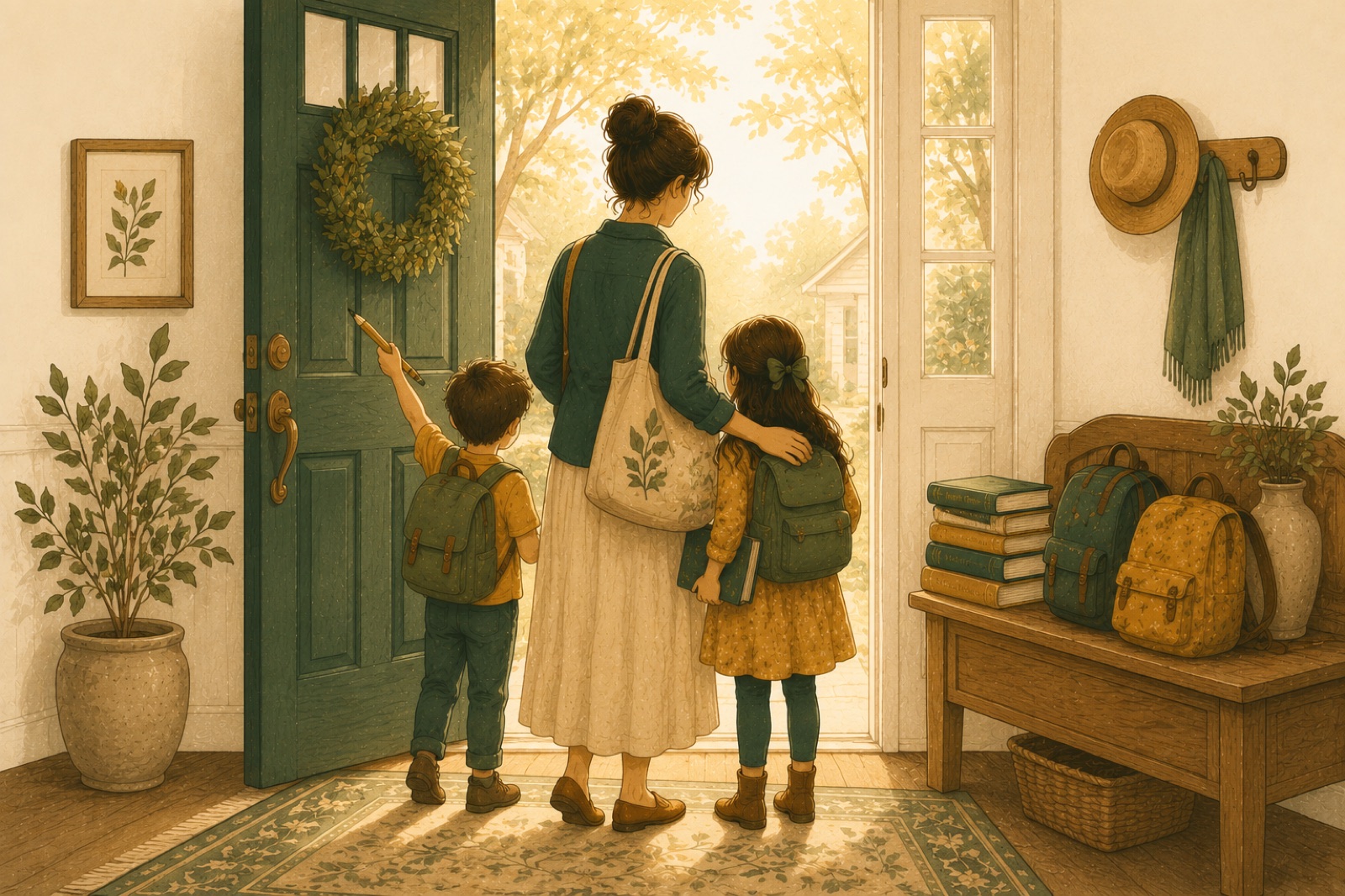
Somewhere between the chalkboard signs, the themed breakfast, and the perfectly staged front-porch photos, the first day of homeschool picked up a reputation it never asked for. If you're bracing for day one like it's a performance — with an audience of grandparents, Instagram, and your own inner critic — take a breath. You don't need a perfect first day. You need a calm first week. Here's a gentle, day-by-day plan for getting there.
Drop the Pinterest-perfect first day
The pressure is real, and it's worth naming. The internet is full of first days that look like magazine shoots: color-coordinated school corners, elaborate breakfast spreads, children beaming over brand-new workbooks. What the photos don't show is the meltdown twenty minutes later, or the mom who spent three evenings crafting a banner and started her year already exhausted.
Here's the quiet truth veteran families will tell you: the first day doesn't set the tone for your year. The first month does. A flat first day is forgotten by October. A parent who burned out making day one spectacular — and then tried to launch a full schedule on day two — is felt all year. Spend your energy where it compounds: on a first week that ends with everyone wanting to come back for week two.
The first week of homeschool has one job
That job is rhythm — not academics. Nothing your child learns in the first week of homeschool will make or break the year. Whether long division starts on day one or day nine is academically irrelevant. What does matter is what your children learn about how home education feels: Do we start around the same time each day? Does Mom seem calm or frazzled? Is this going to be okay?
Week one teaches your kids what homeschool feels like. The curriculum can wait a few days; the feeling can't be redone.
So the goal for week one is modest and specific: establish when the day starts, roughly what order things happen in, and the fact that lessons end — reliably, before anyone is in tears. Content is the passenger this week. Rhythm is driving.
A gentle ramp: day by day
Instead of launching the full schedule Monday morning, ramp into it. Here's the shape:
- Day 1: traditions, photos, and one short lesson. Do the fun stuff — the porch photo, the special breakfast, the interview questions (more on those below). Then do exactly one short lesson, ideally your child's favorite subject, and declare school done by lunch. Yes, really. Day one's only message is: this is going to be good.
- Days 2–3: add one subject a day. Keep the anchor lesson from day one and layer in one more subject each morning. Two subjects Tuesday, three Wednesday. Keep every lesson short and end each day on a win, not a battle.
- Days 4–5: the full-ish schedule at half depth. Run the whole lineup in its intended order, but cut every lesson's length roughly in half. You're rehearsing the shape of a normal day — the transitions, the order, the snack break — without demanding a normal day's stamina from anyone.
By Friday afternoon, your kids have lived a complete school day without ever having a hard one. Next week, you lengthen the lessons you already rehearsed. That's the whole trick.
First-day traditions worth stealing
Traditions are the part of the Pinterest first day worth keeping — they're low-effort, high-memory, and your kids will ask for them every year. A few favorites:
- The first-day interview. Ask the same questions every year and write down the answers: What do you want to be when you grow up? Favorite food? What do you want to learn this year? By year three, the answers are family treasure.
- Handprints or height marks. A painted handprint on the same page, or a pencil line on the same doorframe, every August. Thirty seconds of effort, a decade of payoff.
- The new-book unboxing. Save the curriculum boxes and let the kids open them ceremonially on day one — flipping through fresh books they're allowed to be excited about is half the magic of a new year.
- A first-day treat that only happens on first days. Donuts, a picnic lunch, an afternoon at the creek. Scarcity is what makes it a tradition.
What to skip entirely in week one
Just as important as what you do is what you refuse to do. In week one, skip:
- The hardest subject battles. If handwriting was last year's war, it does not appear before Thursday — and then only briefly.
- Timed anything. No timed math drills, no reading-fluency stopwatches. Week one is the wrong week to measure.
- Formal assessments. Placement tests can wait until week two or three, when a wobbly answer reflects knowledge instead of nerves.
- Perfect attendance at outside activities. If co-op, sports, and music lessons all start the same week as school, something will crack — and it will probably be you. Stagger the starts if you possibly can.
- Grading and record-keeping perfectionism. Jot what you did in one line a day. The beautiful system can start in week two.
Watch your kids, and take notes
While the schedule is light, your most valuable job is observation. Every child has a peak focus window, and week one — with its short lessons and low stakes — is the perfect lab for finding it. Watch for: When is each child sharpest? Who needs movement between subjects, and who gets derailed by it? How long can each one actually attend before quality falls off a cliff? Does the day run better when math comes first, or after something easy?
Write these down — actually write them, don't trust August-brain to remember. These notes are the raw material for your real schedule, and they'll also give you an honest answer to the question every new homeschooler asks: how long should a homeschool day actually be? (Spoiler: shorter than you think, and week one's observations will prove it.)
How week one feeds the year plan
If you've already sketched your year the way we recommend in our guide to planning your whole homeschool year — terms and breaks first, subjects as flexible sequences rather than date-locked schedules — then week one is where the plan meets reality, gently. Nothing you learn this week breaks anything. You discovered your eight-year-old is sharpest at 8:30 a.m.? Move math to the first slot. Lessons are running long? Trim the projection. A plan built as a sequence absorbs all of it.
That's also the week-one review we'd urge you to schedule: Friday afternoon, ten minutes, coffee in hand. Adjust the order of subjects, adjust the start time, adjust your expectations — then walk into week two with a schedule shaped by five days of real evidence instead of July optimism. (If you'd rather make those adjustments in an app that reshuffles the whole year for you — and prints a fresh planner when you're done — that's exactly what we built at Lumen Domus Schola.)
Starting homeschool isn't a single dramatic morning. It's a quiet ramp: one good lesson, then two, then a full gentle week — and a parent calm enough to enjoy it. Take the porch photo. Eat the donuts. Do one lesson. You're going to be okay.
Plan your year with Lumen Domus Schola
Lumen Domus Schola is open now and runs right in your browser — the iPhone and Android apps come this fall. Try everything free for 5 days; cancel before the trial ends and you pay nothing.
Start your 5-day free trial