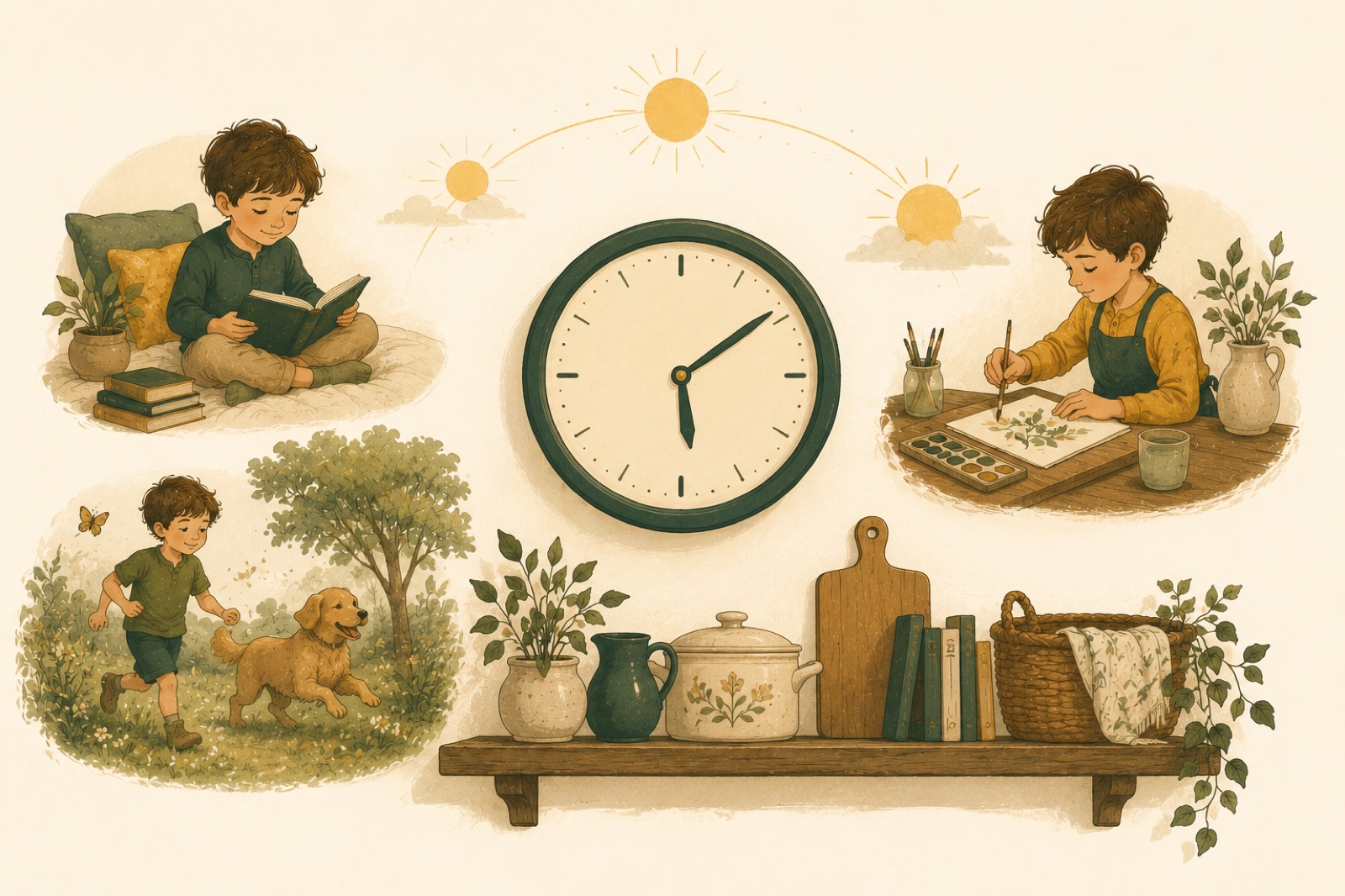
Ask a new homeschool parent what worries them most and "how many hours a day homeschool actually requires" is usually near the top of the list. The math seems obvious: school runs six or seven hours, so home should too, right? Wrong — and happily so. Most experienced families finish formal lessons in a fraction of that time, and their kids don't fall behind. Here's why, with realistic numbers for every grade.
Why homeschool hours don't equal school hours
A classroom day is long because a classroom is a crowd. One teacher and twenty-five students means attendance, lining up, passing out papers, waiting for the last kid to find his pencil, transitions between rooms, assemblies, lunch duty logistics, and re-explaining things half the class already understood. None of that is instruction. Studies of classroom time consistently find that only a modest slice of the school day is actual engaged learning — the rest is the overhead of managing a group.
At home, the overhead disappears. One-on-one attention is astonishingly efficient: your child is never waiting for twenty-four other kids, never re-covering material she already knows, and never sitting through a lesson pitched at somebody else's level. When she's confused, you see it in real time and fix it in two minutes instead of discovering it on a Friday quiz. An hour of focused work at the kitchen table routinely accomplishes what a classroom needs three hours to do.
You're not recreating school at home. You're doing something structurally more efficient.
Homeschool hours by grade: realistic ranges
Every family is different, but decades of collective homeschool experience have settled into surprisingly consistent ranges. These numbers refer to focused, formal lessons — not the reading, playing, and living-room conversations that fill the rest of the day.
- Kindergarten through 2nd grade: 1–2 hours. Short lessons, taken in small bites. Fifteen minutes of phonics, fifteen of math, a read-aloud, some handwriting — done. Young children learn in bursts, and pushing past their attention span teaches them mostly that school is miserable. If your kindergartner finishes everything in ninety minutes, you're doing it right.
- 3rd through 5th grade: 2–3 hours. Lessons get a bit longer and writing becomes real work, but a morning is still plenty. Many families in these grades do all formal work before lunch and keep afternoons for projects, sports, and free reading.
- Middle school: 3–4 hours. More subjects, more writing, the beginnings of independent study. This is the stage where a student starts working from her own list rather than at your elbow for every subject.
- High school: 4–6 hours, mostly independent. Credit-bearing coursework genuinely takes time — but by now the bulk of it is your teen working on her own while you act as advisor, editor, and occasional algebra lifeguard. Six hours of a high schooler's day is not six hours of yours.
Notice the shape: hours rise slowly with age, and the parent's hands-on share falls. A family with a 1st grader, a 5th grader, and a 9th grader isn't running three full school days — they're running one busy morning.
What actually counts as school
The ranges above look small partly because parents undercount. If you tally only workbook pages, you'll miss half of what your children are learning. All of this is school:
- Read-alouds — literature, history, and vocabulary in their most enjoyable form.
- Nature walks — science observation that no worksheet matches.
- Baking — fractions, measurement, chemistry, and following multi-step instructions, with a snack at the end.
- Board games, documentaries, museum trips, an hour lost in an atlas — logic, narration, geography, curiosity doing its own homework.
When people ask how homeschoolers cover everything in three hours, the honest answer is that they don't — they cover the formal skeleton in three hours, and education keeps happening all day in clothes that don't look like school.
Homeschool schedule length: signs your day is too long — or too short
Rather than aiming for a number, watch your actual children. The day is probably too long if: tears or dread show up regularly, lessons drag past attention spans into diminishing returns, there's no time left for free play or boredom, or you're exhausted by 1 p.m. every single day. Length is not rigor; a bloated schedule usually means too much curriculum, not too little learner.
The day might be too short if: "done in 20 minutes" means work is being skipped rather than finished, your child never encounters anything hard enough to require effort, skills like math facts or handwriting are visibly stalling, or the schedule exists mostly on paper. The fix is rarely more hours — it's more consistency across the week.
Structure the hours you do have
A short day works best when it's shaped well:
- Front-load the hard subjects. Math and writing take the most focus, so give them the freshest brains — usually first thing in the morning, right after breakfast.
- Alternate heavy and light. Follow an intense lesson with a read-aloud or something hands-on. Rhythm keeps a morning humming.
- Protect a consistent start time. The most common cause of a five-hour homeschool day is a 10:45 start. Begin at the same time daily and the whole day shrinks.
- Pick a structure that fits your family. Whether that's block, loop, or checklist scheduling, a deliberate structure beats deciding what's next fifteen times a morning.
- Plan sequences, not clock times. Knowing what comes next in each subject matters far more than what time it happens — the approach we walk through in how to plan your whole homeschool year.
This is also where a light planning tool earns its keep. In Lumen Domus Schola, you lay out each subject as a sequence once, and the app projects it across your real weeks — so a two-hour morning always knows exactly what it's for, and a disrupted day just slides forward instead of falling behind.
If you're worried you're "not doing enough"
Almost every homeschool parent carries this worry, and almost none of them need to. Remember what you're comparing against: not seven hours of instruction, but seven hours of school — most of it logistics your home doesn't have. Your child gets something no classroom can offer at any length: an adult who notices, every single day, exactly where she is and what she needs next.
Depth of attention beats seat time. It isn't close. Two focused hours with a parent who stops and re-explains the moment a concept wobbles will outrun a long institutional day, year after year. So if your mornings are short, your afternoons are full of books and mud and Lego, and your kids are progressing — you're not doing school wrong. You're doing home right.
Plan your year with Lumen Domus Schola
Lumen Domus Schola is open now and runs right in your browser — the iPhone and Android apps come this fall. Try everything free for 5 days; cancel before the trial ends and you pay nothing.
Start your 5-day free trial