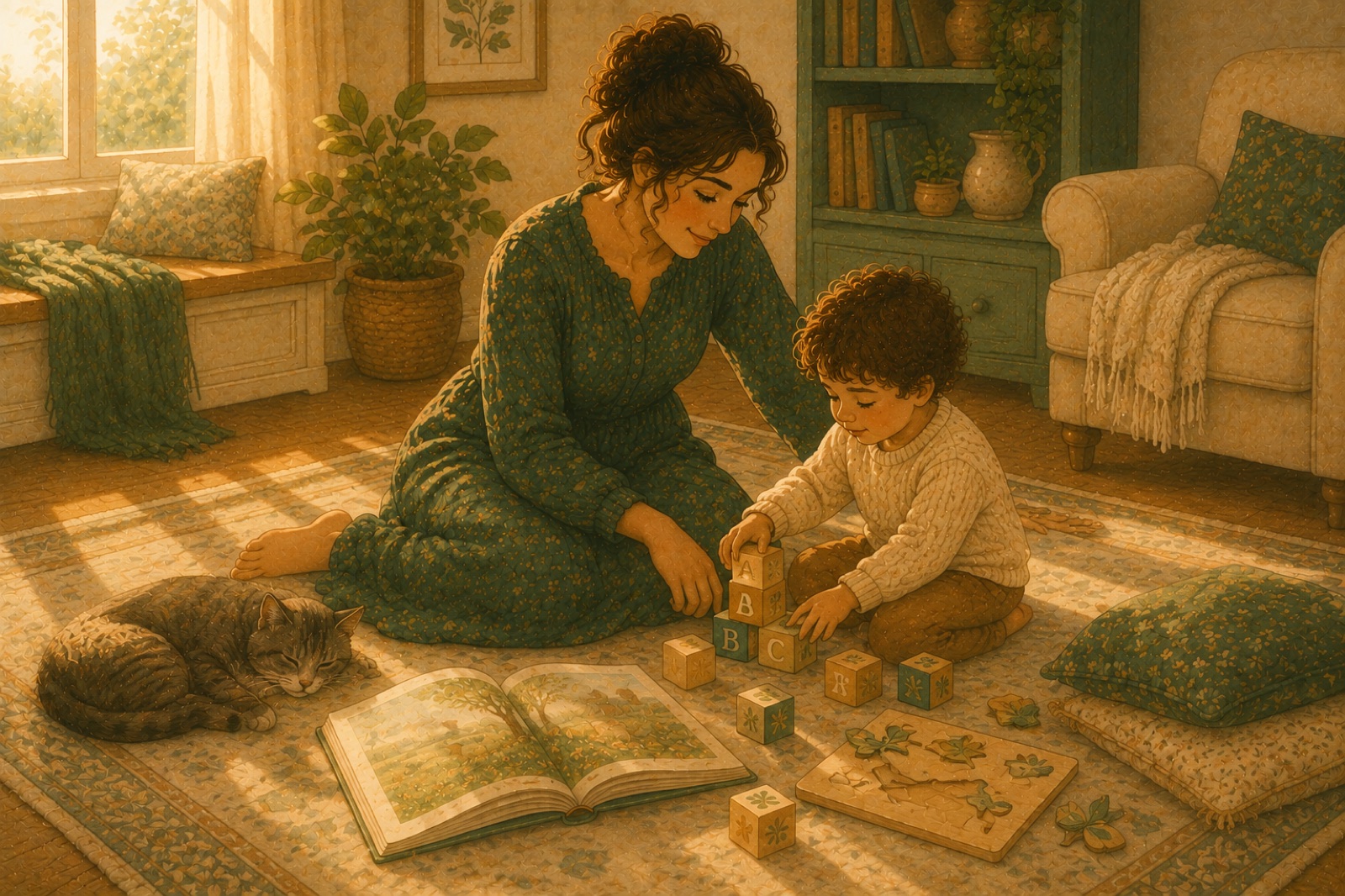
Almost every parent building their first kindergarten homeschool schedule builds one that's too long. It's an understandable mistake — you picture a school day and shrink it slightly. But five-year-olds don't need a shrunken school day. They need something much smaller, much warmer, and much more effective than most new homeschool parents dare to believe.
Why kindergarten worries parents most
Of all the years to homeschool, kindergarten generates the most anxiety per hour of actual work. Partly it's the visibility — everyone you know has an opinion about whether your five-year-old should be in school. Partly it's the stakes: this is the year you find out whether you can do this at all.
So you overbuild. You buy the boxed curriculum with four subjects a day, you set up a classroom in the dining room, and by week three you have a child who cries at the sight of a workbook and a mother wondering what's wrong with her. Nothing is wrong with her — and nothing is wrong with you. Your schedule was simply built for a child who doesn't exist: a five-year-old with the attention span of a fourth grader.
How long a kindergarten homeschool day actually is
Sixty to ninety minutes — that's the honest range for formal, sit-down work at this age, and the low end of it is perfectly respectable.
That number shocks people, so it's worth saying plainly why it's enough. A kindergarten classroom day runs six hours because it contains twenty-two other children — lining up, snack time, sharing circle, bathroom trips in groups, waiting. Strip the crowd out and what remains is startlingly small: a bit of phonics, a bit of counting, a story, some drawing. At home, that's an hour. As we covered in how many hours a day homeschooling takes, the gap between school hours and instruction hours is widest in the youngest grades.
If your kindergartner is done before lunch, you are not cutting corners. You are simply not running a classroom.
What a real morning looks like
Here's a shape that works for a great many families. Times are approximate on purpose:
- Breakfast and a read-aloud (20 minutes). A picture book or a chapter of something gentle. This is not a warm-up for school — it is school, and it's doing more for vocabulary and comprehension than any worksheet in the house.
- Phonics or early reading (10–15 minutes). Short and daily beats long and occasional. When the wiggling starts, stop. A ten-minute lesson done every day for a year is enormous progress.
- Movement (as long as it takes). Outside if at all possible. This isn't a break from learning — a five-year-old body that has moved is a five-year-old brain that can sit.
- Numbers (10–15 minutes). Counting, sorting, patterns, simple addition with real objects. Buttons and dried beans outperform most math programs at this age.
- Something with their hands (15–20 minutes). Drawing, painting, play dough, cutting, building. Fine-motor work is handwriting readiness, and it looks like play because it should.
Add it up and you're at roughly seventy-five minutes, with the whole afternoon still ahead of you. That afternoon — the playing, the wandering, the endless questions — is where a great deal of the actual education happens.
The four things that really matter at five
If everything else fell away, these four would carry the year: being read to, learning letter sounds, playing with numbers concretely, and using their hands. That's the whole essential curriculum for kindergarten. Everything else — the science kit, the history spine, the second language — is enrichment, and enrichment is wonderful right up until it becomes the reason a five-year-old dreads the morning.
Notice what isn't on the list: seat time, handwriting drills for children whose hands aren't ready, and anything that produces a page to file. Those aren't harmful in small doses. They're just not what this year is for.
What you can safely skip
Skip the daily worksheet packet — your five-year-old can demonstrate everything a worksheet asks by telling you the answer out loud. Skip formal spelling and grammar entirely; both arrive naturally later, and early drilling mostly teaches children that words are a chore. Skip the elaborate classroom setup if it's stressing you out. And skip comparing your child's pace to any other child's — including the one down the street who is apparently reading chapter books.
That last one deserves its own sentence, because it causes more damage than any curriculum choice: reading readiness varies by years, not months, and the spread is completely normal. Some children read fluently at four. Some don't click until seven and go on to devour books for the rest of their lives. The age it happens tells you remarkably little about the reader they'll become.
When your child isn't ready — and that's fine
Sometimes you'll do everything right and the child in front of you still isn't ready. The letters won't stick. Sitting for ten minutes is genuinely hard. This is information, not failure.
The response is to back off and try again in a month or six weeks — not to push harder. Nearly every experienced homeschool parent has a story about a child who couldn't hold a pencil in September and was writing sentences by spring, and almost none of them credit persistence for the change. They credit waiting. There is no prize for early, and there's a real cost to a child who decides at five that learning is something unpleasant that happens to them.
Making the little you do consistent
Here's the paradox of this age: because the work is so small, it's unusually easy to let it evaporate. Fifteen minutes of phonics is the first thing to vanish on a hard week, and vanishing weeks stack up quietly.
Consistency, not volume, is what carries a kindergarten year — which is really a planning problem rather than a teaching one. In Lumen Domus Schola, you lay out your handful of short daily pieces once and let the app project them across your real weeks, so a seventy-five-minute morning always knows what it's for, and a day you miss simply slides forward instead of disappearing. Seeing that you've done phonics thirty-one days in a row turns out to be worth a great deal on the mornings you'd rather not.
The year you'll be glad you didn't rush
Kindergarten at home is not a scaled-down first grade. It's a year for learning that books are a delight, that letters make sounds, that numbers describe real things — and, quietly underneath all of it, that this new arrangement is safe and pleasant and yours.
You'll be tempted all year to do more — resist it a little longer than feels comfortable. An hour a day with a five-year-old who still likes learning is worth more than three hours with one who doesn't. And you have twelve years to teach the rest.
Plan your year with Lumen Domus Schola
Lumen Domus Schola is open now and runs right in your browser — the iPhone and Android apps come this fall. Try everything free for 5 days; cancel before the trial ends and you pay nothing.
Start your 5-day free trial